On a recent trip to Germany, I made a stop at Motorworld Köln, a destination that has quickly become a hub for car enthusiasts. The complex houses restaurants, a hotel, classic car storage facilities, and showrooms for automotive brands. Hidden within it, however, is something particularly special for motorsport fans, the permanent display of Michael Schumacher’s personal collection.
The exhibition brings together a remarkable selection of cars and memorabilia from Schumacher’s career, including early karting machines, sports cars, trophies, and many of the Formula 1 cars that carried him to his record-breaking seven World Championships.

My earliest memories of motorsport come from trips to Santa Pod Raceway or waking up early to watch Formula 1 races live on TV with my family.
Like many fans of that era, I quickly became a supporter of Michael Schumacher. His aggressive, precise driving style combined perfectly with the striking Benetton cars of the early 1990s, and it didn’t take long before he became the driver everyone was chasing.
Over the course of his career Schumacher achieved:
7 World Championships
91 Grand Prix victories
155 podium finishes
68 pole positions
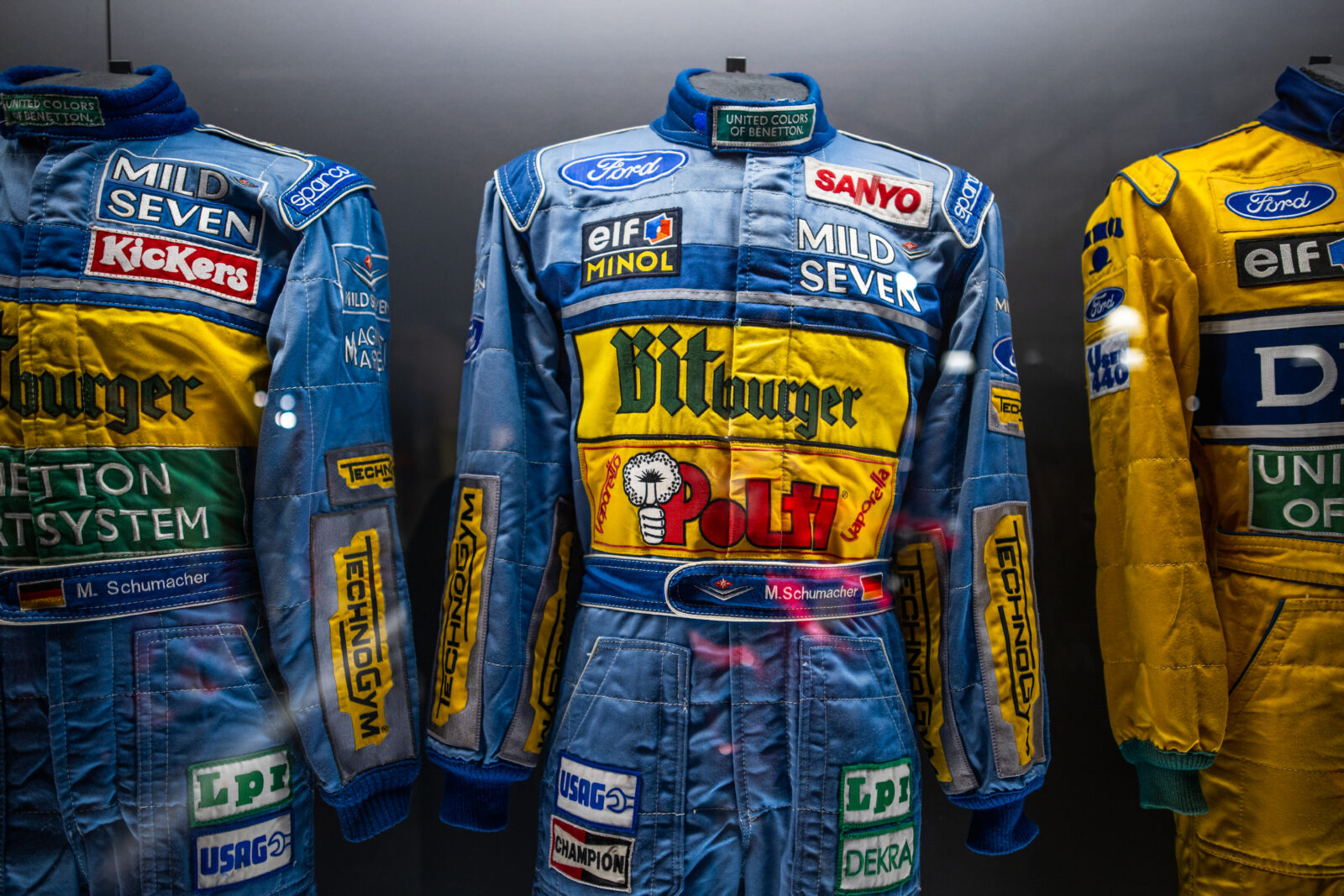
Seeing so much of that history gathered together in one place is something truly special for any motorsport fan.


The collection begins with Schumacher’s Tony Kart, representing the start of a journey that would lead to the very top of motorsport.
Suspended above the bar area nearby is his 1988 European Formula Ford car, followed by the 1989 Reynard 893 Formula 3 car, a key step in his rise through the single-seater ranks.
These early machines provide a fascinating look at the beginnings of a career that would soon change Formula 1 forever.


Schumacher’s Formula 1 debut came in 1991 with the Jordan 191 at the Belgian Grand Prix.
Despite never having raced at Spa-Francorchamps before, he stunned the paddock by qualifying 7th. Unfortunately, a clutch failure forced him to retire on the first lap.
Even so, the performance was enough to turn heads across the pit lane. Within days he had secured a seat with Benetton, a move that would launch one of the most dominant careers in Formula 1 history.


Among the Benetton machines on display are the Camel-liveried Benetton B191B and the Benetton B195, the latter being the car that carried Schumacher to his second World Championship in 1995.

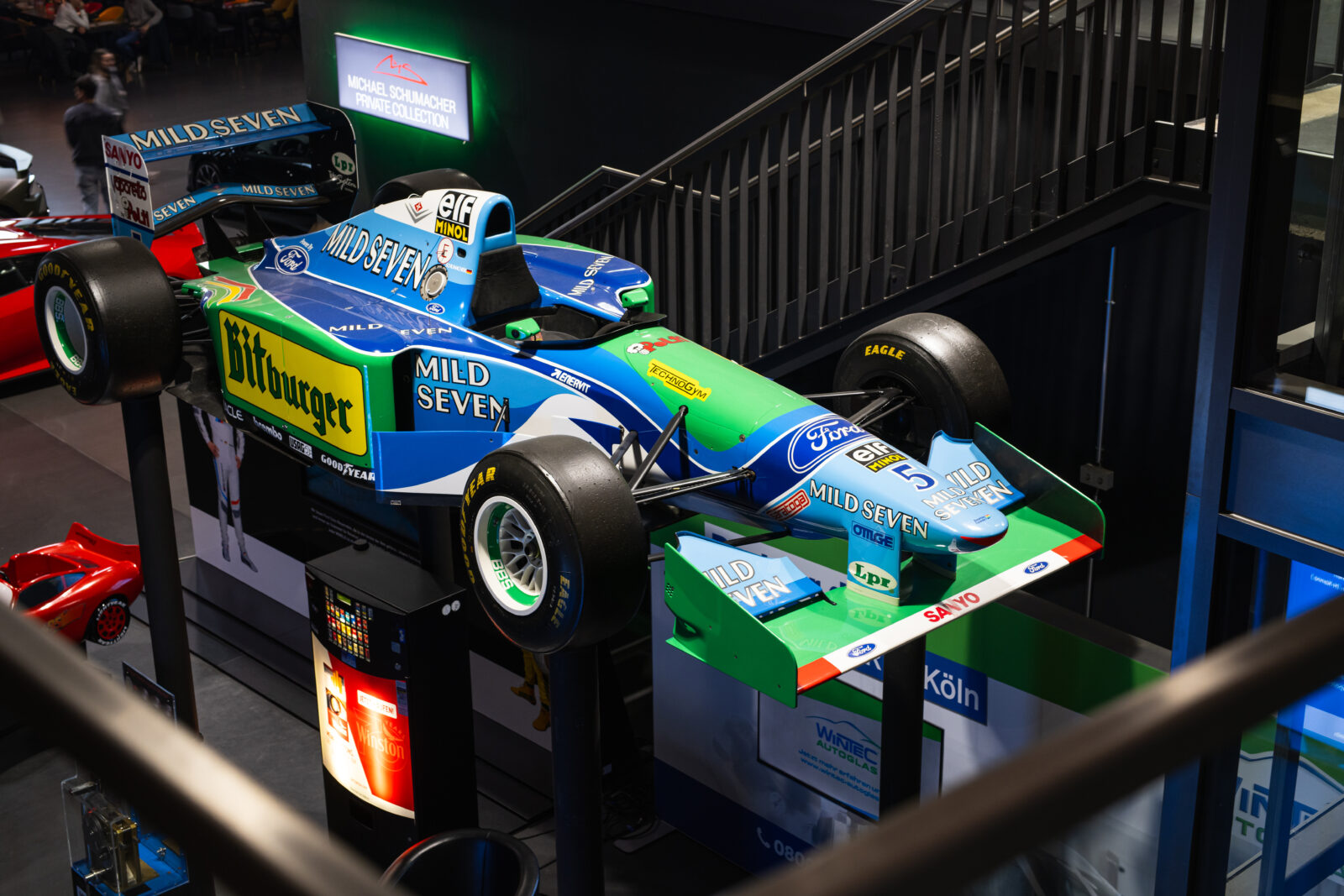
Also featured prominently in the collection is the Benetton B194, the car that delivered his first World Championship in 1994. It’s mounted beside one of the staircases, allowing visitors to view it from several angles – an excellent way to appreciate the design details of the era.
In 1996 Schumacher made the bold move to Ferrari, a team that had not won a drivers’ championship in nearly two decades.
One of the earliest cars from that period in the collection is the Ferrari F310. While it wasn’t the most competitive car on the grid, its unusual sidepod design made it one of the most distinctive Formula 1 cars of its time.

From there the display continues through a stunning line-up of Ferrari F1 cars that represent the team’s gradual rise back to dominance.
Each car is displayed within a glass enclosure, protecting them while still allowing visitors to get remarkably close to these important pieces of Formula 1 history.


Walking through the exhibit also highlights how dramatically Formula 1 design evolved during this era – wings grew more complex, aerodynamic surfaces multiplied, and every curve changed in the relentless pursuit of speed.


Beyond the cars themselves, the collection includes several deeply personal pieces of memorabilia.
One of the most moving items is a Ferrari chassis model sent to Schumacher after his crash at Silverstone in 1999, where he suffered a broken leg. Ferrari team principal Jean Todt wrote a “get well soon” message on the model, and every member of the team signed it.


Another special item is a Ferrari front wing presented to Schumacher after his 2002 World Championship victory, also signed by many members of the team.
These pieces provide a rare glimpse into the strong relationship between Schumacher and the Ferrari team during their most successful years.

The exhibition also includes two cars on loan from the Mercedes-Benz Museum.
The first is the 1991 Sauber-Mercedes C291, representing Schumacher’s connection with Mercedes early in his career through their junior programme.
The second is a 2010 Mercedes-AMG F1 show car, reflecting Schumacher’s return to Formula 1 with the Mercedes team later in his career.


Walking around the collection filled me with nostalgia. I found myself not only fascinated by the cars and thinking about how best to photograph them, but also remembering the many races I watched growing up as Schumacher dominated Formula 1 in a way the sport had never seen before.
For fans of Formula 1, it’s a rare opportunity to stand just a few metres away from machines that defined an era of the sport.


Even if you’re not a Ferrari fan, or even a Schumacher fan, the exhibition is well worth visiting if you find yourself in Cologne. Few places offer the chance to see such a large and significant portion of Formula 1 history gathered in one location.
The Michael Schumacher Collection is located inside Motorworld Köln, just outside the centre of Cologne in Germany. The venue is easy to reach by car or public transport and is surrounded by restaurants, showrooms, and classic car storage facilities.
For motorsport fans visiting Cologne, it’s one of the most unique automotive attractions in the region.
And perhaps the best part of all? Entry to the collection is completely free!


If you’d like to see more of my photography, you can follow me on my social channels:
Facebook – facebook.com/RBorowikMedia
Instagram – instagram.com/robertborowikmedia
YouTube – youtube.com/@robertborowikmedia
You can also visit my store if you’d like to purchase prints of any of my images.